Men’ Sheds in Japan
8 November 2023
Professor Barry Golding, with generous contributions and assistance from Dr Ayahito Ito (University of Tohoku: ayahito.ito@gmail.com) and Dr Risa Takashima (University of Hokkaido: risa-t@hs.hokudai.ac.jp), Japan
Preamble
Barry Golding visited Sapporo in Japan in early November 2024 to meet with researchers and shedders involved in one of only two ‘pilot’ Men’s Sheds then open in Japan. Barry is grateful to the men of the Pokke Kotan Men’s Shed in Sapporo and its key facilitators and researchers, Dr Ayahito Ito (affiliated with Tohoku University) and Dr Risa Takashima (from University of Hokkaido), Japan for sharing the information, which he has used as a basis for this English summary. Barry gratefully acknowledges support from the JST-RISTEX project for helping facilitate this visit and making several presentations to shedders, researchers and other stakeholders.
My Intention
I am sharing this information more widely via this blog, as many shedders around the world are very interested in what shedders and their supportive stakeholders are attempting. I have made them aware that other Men’s Sheds and shedders around the world are there to support and inform them on request.
I am convinced, from what I have seen and heard, of the considerable potential of Men’s Sheds, to address the needs of some older Japanese men. While grassroots Men’s Sheds on the Australian model have worked well and become active social movements in eight mostly English speaking, ‘Western’ nations, this is the first time Men’s Sheds have been seriously attempted in an Asian nation, Japan.
What follows is my brief summary of where Men’s Sheds are at in Japan as of November 2024. In summary, one Shed which I have visited is open in suburban Sapporo, in Hokkaido in far northern Japan. A separate but related Shed is open in Kyushu in far southern Japan, approximately 3 hours and 15 minutes flight time away. My information about this second Shed is limited to what I have been able to determine from a distance, limited by my non-existent Japanese language skills and limited English language skills of the main contact, Takashi Matsuo (Assistant Professor, Kumamoto Health Science University).
My message to all of these pilot projects, based on national shedder experience elsewhere, is to communicate and collaborate ‘Shoulder to Shoulder’ like the shedders themselves, rather than working separately or competing. I anticipate that the ‘Japan Community Shed Association’ will progressively take on some of these national coordination roles, with direct shedder and stakeholder representation.
Achieving a successful cultural translation of the Australian Men’s Shed model beyond the pilot phase will likely require cultural adaptation. What is learnt through experience and well as from research and evaluation from these pilot projects (about what works and what does not work) will be very important.
‘The Men’s Shed in Hokkaido’ and ‘The ‘Men’s Shed in Kyushu’ in Kyushu, summarised in what follows, are part of the same JST-RISTEX project. The project originated in October 2022 when a Men’s Shed initiative titled ‘Citizen Support Project for Preventing Social Isolation and Loneliness’ started with the support of funding from Japan Science and Technology Agency Research Institute of Science and Technology for Society (JST-RISTEX) (FY2022-2026).
The primary purpose of this project is to establish Men’s Sheds in Japan and evaluate the effect of the Men’s Shed intervention from the perspective of qualitative and quantitative research. There are two active Men’s Sheds now open to November 2024, being developed and researched in parallel via this RISTEX initiative, in Hokkaido (northern Japan) and Kyushu(southern Japan).
The Men’s Shed in Hokkaido
Following an initial meeting in November 2022, the RISTEX proponents including Dr Ayahito Ito began to move forward to establish a Men’s Shed in Mizukami-village, Kumamoto prefecture and Sapporo city, Hokkaido prefecture.
In April 2023, Dr Risa Takashima, a researcher specialising in occupational therapy, along with their graduate student and a retired eldercare professional, began looking for men interested in helping establish the Sapporo Men’s Shed.
Dr Takashi Matsuo (Kumamoto Health Science University) and Dr Risa Takashima started joint interview and participant observation with the aim of seeking core members of the Shed, in the Kumamoto area of Kyushu, and in suburban Sapporo, Hokkaido respectively.
In April 2024, the Sapporo Men’s Shed, now officially named “Pokke Kotan,” was formally launched with 41 members aged between 50 and 84. Pokke Kotan is a First Nations Ainu[1] term that means “warm village”, reflecting a commitment to create a welcoming community for shedders.
In June 2023, preparations began to establish the Sapporo Men’s Shed with six founding members. By July, one more member joined, bringing the total number of founders to seven. In July 2024, a local construction company generously provided a former vacant house that they had used as a storage space.

Over the following months, shedders worked together to clean and repair the space, see above, preparing it for use as a Shed.
Until March 2024, the research team continued qualitative field research and identified a future leader of the Shed. Since then, core members have coalesced around him. A local company generously provided with a former vacant house that they had used as a business office.
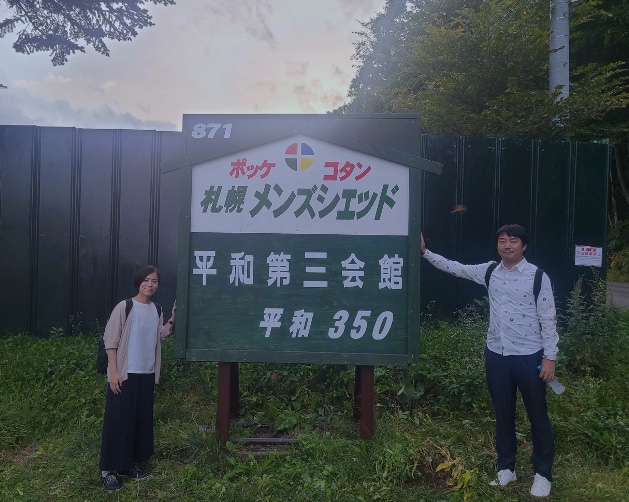
In November 2024, together with the local residents and other community stakeholders, an open house event was conducted to introduce “Pokke Kotan” as a dedicated space for men in the community. Here is the sign outside the Shed in Japanese with Dr Risa Takashima (left) and Dr Ayahito Ito (right). Translated from Japanese, the main part of the sign says Pokke Kotan Men’s Shed[2]. Note the inclusion in the sign of the four primary colours of the United Nation Millennium Development Goals.
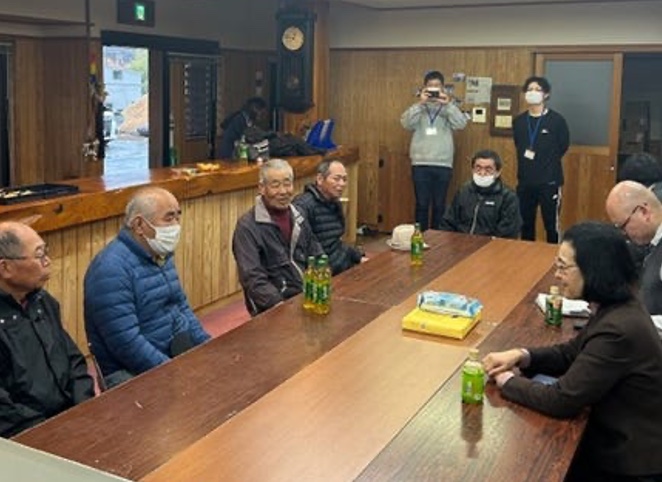
Below is a photo taken during Barry Golding’s presentation, Men’s Sheds: Australia’s Gift to the World in the Pokke Kotan Men’s Shed on 2 November 2024, ably assisted by an interpreter (seated partly obscured at left).

The evening after my presentation many of the men involved from the Men’s Shed welcomed me to a dinner they had organised in a local community centre. Here is a photo of the men (Taken by Dr Ito, including myself(seated centre), Dr Risa Takashima (blue jacket, towards the left) and Dr Takashima’s PhD student, Rita Hirayama (striped top seated at far left). Everyone deliberately adopted a ‘Shoulder to Shoulder’ pose with crossed arms.

NOTE: The Shed has a website in Japanese, though it would not open safely when the link provided was tested, so it is not included here.
The Men’s Shed In Kyushu
On 30 November 2023 another Shed started in the small village of Mizukami, in Kumamoto prefecture in Kyushu, southern Japan. It is called Men’s Shed “Yo-Ro-Ya”(寄郎屋). The name loosely translates into English as “Let’s get together”(寄ろう) and “Men’s Shed”(屋.)
The first activity of the shedders was cleaning and renovating the space, preparing it for use as a Shed. Simultaneously, they started making advertising displays made of wood with chainsaws and bamboo charcoal (see below).

On 1 February 2024, the Yo-Ro-Ya shedders and stakeholders were interviewed by the Cabinet Secretariat’s Office for Isolation and Loneliness. Ms Yamamoto, head of the office, said: ‘Not much time has passed since the start of the Shed, but things are starting to go well. There are positive side effects, such as women and children showing up. So it has the potential to become a hub for people-to-people links.’
As a quick update, in November Assistant Professor Takashi Matsuo noted that ‘the men from our Shed began selling bamboo charcoal in October 2024. Our group has grown to fifteen members this year a notable number for our village of 2,000 people.’ Dr Matsuo hopes to build on they success and help create another Shed within the Kumamoto prefecture.
Yo-Ro-Ya has no website but they update their activities on Instagram in Japanese (see account @yorouya2023 on Instagram).
The main (Japanese speaking) contact for this Men’s Shed in Kyushu is Assistant Professor Takashi Matsou (matsuo-ta@kumamoto-hsu.ac.jp).
Tokyo Metropolitan Institute of Gerontology (TMIG) and its plans for Men’s Sheds
The Tokyo Metropolitan Institute of Gerontology (TMIG: located approximately midway between these RISTEX initiated Sheds, in the Japanese capital city, Tokyo) has plans to develop pilot Men’s Sheds in Tokyo in the future, and has separately applied for funding for implementation and research related to men’s social participation. The main contacts for this parallel TMIG initiative (who can respond in English, and whom I visited and presented to in Tokyo in 2023) are Dr Kumiko Nonaka (knonaka60@gmail.com) and Professor Hiroshi Murayama (hmurayama_tky@yahoo.co.jp).
[1] The Ainu are an Indigenous (First Nations) people who primarily inhabit the island of Hokkaido in Japan, but also live in the north of Honshu, Japan’s main island, and Sakhalin Island in Russia. There are more than 24,000 Ainu in Japan.
[2] About the ‘871’: The house was given by Hanai-gumi, a construction company. Japanese read 871 as ‘Hanai’. A part of Hachi (8)-Nana (7)-Ichi (1), that is Ha-Na-I; the number 350 is the house’s address.
 Barry Golding
You must be logged in to post a comment.